10 Clear Signs Your Business Needs Managed IT Services

As businesses in Australia navigate a dynamic digital landscape, staying competitive hinges on having a reliable and efficient IT infrastructure. However, managing your IT systems in-house can often become a daunting and resource-intensive task.

This is where managed IT services can become an asset for your business. Managed IT providers offer end-to-end solutions like network management, cybersecurity, and cloud support, letting you focus on core operations while experts ensure smooth and secure technology performance.

Not sure if it’s time to make the shift? We’ll walk you through 10 telltale signs that your business could benefit from managed IT services
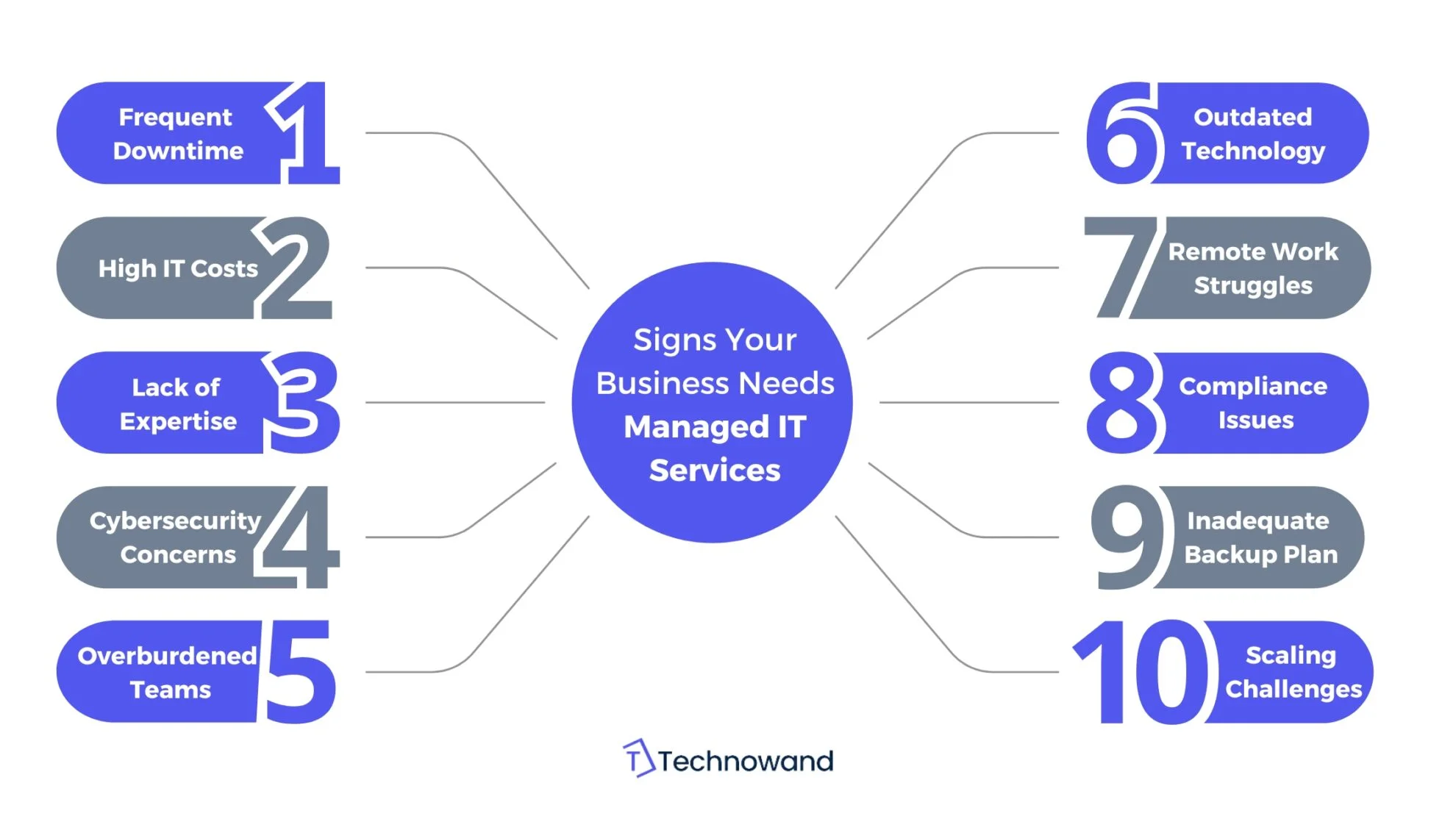
1. Frequent Downtime Is Affecting Your Bottom Line

Unplanned downtime is one of the most disruptive challenges a business can face. It not only halts operations but also incurs significant financial losses. Small to medium-sized businesses can lose up to $9000 per minute in downtime, damaging revenues, customer trust, and employee morale. Managed IT services proactively monitor your systems, identifying and addressing vulnerabilities before they cause major disruptions.

Think through these to see if downtime is derailing your business outcomes:

  • How frequently does your business face unplanned downtime?
  • How much time and money are spent addressing IT issues after they occur?
  • Are system outages or technical glitches a regular obstacle to your operations?
  • How significantly do downtime incidents impact employee productivity and customer satisfaction?
2. Your IT Costs Are Unpredictable

IT expenses that fluctuate unpredictably can cause budget strain and leave little room for strategic investments—a sign it’s time for some pivots. When repairs, upgrades, or emergency fixes arise unexpectedly, it becomes difficult to plan costs. Managed IT services offer a predictable pricing model, making it easier to allocate resources and prepare for the future.

Here’s a quick checklist to assess if unpredictable IT costs are draining your business:

  • Unexpected IT repair or upgrade costs frequently disrupt your budget.
  • Unplanned IT expenses eating into funds meant for other critical operations
  • You find it difficult to forecast and allocate your IT budget effectively.
  • Predictable monthly expenses will make financial planning more manageable for your business.
3. You Lack In-House IT Expertise

For small and medium-sized businesses, building and maintaining a full-time IT team can be both costly and resource-intensive. Managed IT services provide access to a skilled team without the burden of full-time salaries, benefits, and training costs. As a result, your business can access expertise without compromising on quality or resources.

If you’re facing these challenges, managed IT services may be the solution:

  • Your team doesn’t have the expertise to manage advanced or complex IT systems effectively.
  • Your current IT staff is stretched thin by routine maintenance and troubleshooting.
  • You have faced challenges in hiring and retaining qualified IT professionals.
4. Cybersecurity Threats Are a Growing Concern

With cyberattacks becoming increasingly sophisticated in Australia, protecting sensitive business and customer data is non-negotiable. A managed IT service steps in with advanced security solutions, such as firewalls, encryption, and proactive threat assessments, ensuring your business remains secure against evolving risks.

If you’re unsure or answering “no” to the following, a managed IT provider could be the solution you need:

  • Has your business experienced or narrowly avoided a cybersecurity breach?
  • Are your current security measures robust enough to handle advanced cyber threats?
  • Do you feel confident in your business’s ability to defend against cyberattacks?
  • Are your security tools, such as firewalls, antivirus software, and threat assessments, consistently updated and effective?
5. Internal Teams Are Overburdened

If IT issues are diverting your team from strategic business goals, it’s time to outsource. Managed IT services handle routine maintenance and technical issues, freeing up your team to channel their time and energy to activities that drive growth and innovation.

If these hurdles mirror your current situation, managed IT support can simplify your workload:

  • Your team is spending far more time handling routine IT tasks.
  • This time can be redirected toward initiatives that contribute to business growth
  • IT issues are frequently pulling your employees away from their primary responsibilities.
  • Your team feels overwhelmed by the demands of day-to-day IT maintenance and troubleshooting.
6. You’re Struggling to Keep Up with Technology Trends

Technology is evolving quickly, and staying on top of technology trends can feel like an uphill battle if you don’t have the right resources. Managed IT services ensure your systems are consistently updated, scalable, and aligned with industry advancements, keeping your business competitive in the Australian market.

If your business is struggling to adapt to technological changes, reflect on these points:

  • Are your systems regularly updated with the latest technology?
  • Do you feel confident your IT infrastructure is prepared for future growth?
  • Is it challenging to implement the latest technologies that could give your business a competitive edge?
7. Your Remote Workforce Needs Reliable Support

As remote work becomes the norm, it’s critical that your team has reliable access to the tools and support they need. Managed IT services provide secure cloud solutions and 24/7 helpdesk support, enabling your remote workforce to stay connected and productive.

If these challenges resonate, you might want to bring a managed IT service on board:

  • Remote employees frequently experience connectivity or access issues.
  • Your current IT setup is not secure and/or scalable enough to support remote operations effectively.
  • Your remote employees frequently encounter security or performance challenges.
8. Compliance Requirements Are Becoming More Complex

In Australia, businesses must navigate a complex landscape of regulations, including the Privacy Act and industry-specific standards. Managed IT services ensure your technology is fully aligned with compliance requirements, reducing the risk of legal issues and keeping your business in good standing.

If compliance concerns are overwhelming your team, consider these questions:

  • Are you confident that your IT systems are fully compliant with regulations?
  • How much time and resources are spent on manual compliance efforts?
  • Are you certain that your IT practices align with Australian laws and industry-specific regulations?
  • Could compliance issues potentially jeopardize your business operations?
9. Your Backup and Recovery Plan Is Inadequate

Data loss can have a devastating impact on your business, leading to operational disruptions and financial setbacks. Without a solid backup and recovery plan, your business is vulnerable. Managed IT services offer fail-safe solutions, ensuring your data is secure and recoverable in case of a disaster.

If you’re concerned about your data’s security, evaluate the following:

  • Do you have an automated backup solution in place that runs regularly?
  • Can you recover quickly from data loss or system failures?
  • Are your backup systems secure, routinely tested, and capable of handling major data loss events?
10. You’re Planning to Scale Your Business

As your business grows, so do the IT challenges—whether it’s scaling infrastructure, managing increasing security risks, or adapting technology to meet evolving needs. Managed IT services provide scalable solutions that grow alongside your business, ensuring your technology evolves to support your expansion.

If you’re planning for growth, consider the following:

  • Is your current IT infrastructure ready to handle increased demand?
  • Do you have the in-house resources to scale your IT systems effectively?
  • Are you prepared to address the heightened security risks and technology demands that come with business growth?
Take Control of Your IT Challenges

Managing IT in-house can become overwhelming as your business evolves. From rising cybersecurity threats to supporting remote teams and ensuring compliance, the challenges are many. Recognize the signs, make the shift, and empower your business with reliable, efficient IT support for a competitive edge.

Partnering with a managed IT provider can transform these challenges into opportunities. From boosting efficiency and fortifying security to ensuring scalability and innovation, managed IT services empower your business to stay ahead in a competitive market.

FAQs on Managed IT Services

Why do you need managed IT services?

Managed IT services are essential for businesses looking to streamline their IT operations, enhance security, and reduce downtime. By outsourcing IT tasks to an expert team, you free up internal resources, ensuring your technology runs smoothly and securely. This also allows you to focus on core business functions while benefiting from proactive monitoring, expert support, and scalable solutions.

How to pick an MSP (Managed Service Provider)?

When choosing an MSP, look for one with proven experience, industry expertise, and a full range of services that meet your specific needs. Ensure they offer 24/7 support, have a solid reputation, and provide transparent pricing. At Technowand, we offer tailored IT solutions that empower Australian businesses to operate efficiently and securely.

What comes under managed IT services?

Managed IT services include proactive monitoring, cybersecurity, cloud management, data backup, disaster recovery, and 24/7 support. These services are designed to ensure your IT infrastructure is secure, efficient, and scalable, allowing your business to function seamlessly and without disruption.

What is the difference between IT consulting and managed services?

IT consulting focuses on strategic advice for specific projects or issues, while managed services provide ongoing management and maintenance of IT systems. IT consulting is typically short-term, while managed services are a long-term partnership where the MSP handles the daily IT operations and support.


How Automation Through Custom Software Saves Time and Money

Running a business today often feels like an endless juggling act. Managing operations, keeping customers happy, and staying on top of daily tasks can leave little room to focus on growth.
You’re not alone—94% of businesses struggle with time-consuming, repetitive tasks that slow them down. While there’s no shortage of software options promising to streamline workflows, finding one that fits your unique needs is easier said than done.
In this article, we’ll explore how leveraging automation through custom software can transform your operations and boost your bottom line.

Why Automation Through Custom Software?

While off-the-shelf automation solutions can be helpful, they often fall short of addressing the unique needs of your business. This is where custom software steps in, offering a solution built specifically to your workflows and goals.

By designing and implementing custom software applications that automate repetitive or time-consuming tasks—such as data entry, invoicing, or scheduling—you can unlock efficiency at every level of your operations. Here’s why it stands out:

  1. Built for You: Designed to match your unique workflows, ensuring maximum efficiency.
  2. Improves Accuracy: Reduces manual errors and speeds up repetitive tasks.
  3. Scalable and Future-Proof: Evolves with your business, easily adapting to growing demands.
  4. Seamless Integration: Works effortlessly with your existing systems.
  5. Gives You an Edge: Streamlines processes and boosts productivity to stay competitive.

By choosing automation through custom software, you’re not just solving immediate challenges—you’re investing in a smarter, more efficient future that saves both time and money. Let’s take a closer look.

The Benefits of Automation Through Custom Software
1. Time Savings

Time is one of the most valuable resources for any business, and automation ensures you’re not wasting it on repetitive tasks. Custom software can take over processes like data entry, report generation, and invoice processing, which are traditionally time-intensive. This shift doesn’t just speed things up—it frees your team to focus on strategic, high-value work that drives innovation and growth.

For example, a retail store can automate inventory tracking. Instead of manually checking stock levels, a custom system updates inventory in real-time and notifies managers when it’s time to reorder. Similarly, a healthcare clinic can automate patient appointment scheduling, reducing time spent on phone calls and manual bookings.

With reduced reliance on additional manpower and minimized costly errors caused by manual work, you save on labor costs while minimizing errors that could lead to financial losses.

2. Cost Efficiency

Custom software doesn’t just reduce costs—it optimizes resource use. Automating tasks like billing, payroll, and compliance reporting allows businesses to lower operating expenses and avoid costly human errors. Over time, the cost savings far outweigh the initial investment in custom software.

For instance, a financial services firm can use automation to streamline client invoicing, ensuring accuracy and avoiding late payments. In education, a school or university can automate attendance tracking, reducing administrative overhead and improving operational efficiency.

Automated systems complete tasks like reporting, billing, or compliance instantly, compared to the hours manual efforts would require.

3. Enhanced Productivity

When repetitive tasks are automated, employees can channel their energy into activities that require creativity, problem-solving, and decision-making. This not only boosts morale but also improves business outcomes.

For instance, a customer service team using custom software to automate ticketing and query routing can resolve issues faster, leading to happier customers and more efficient agents.

Increased productivity means you can achieve more without hiring additional staff and saving on payroll and training expenses.

4. Scalability and Adapatability

Growth is exciting but often brings operational challenges with it. Custom software automation provides a scalable solution that grows alongside your business. By handling increased workloads with the same efficiency, custom solutions ensure that you don’t need to hire a proportional number of employees or expand infrastructure as demand rises.

For instance, a manufacturing company experiencing increased demand for its products can implement custom software to automate production scheduling, inventory management, and quality control. As order volumes grow, the software adjusts production timelines, tracks raw materials in real-time, and ensures quality standards without needing additional staff.

Automation absorbs increased production demands without delays, avoiding the bottlenecks and inefficiencies of manual processes. Plus, scaling operations with automation reduces the need for extra hires, training costs, and overtime expenses.

5. Fewer Errors

Manual processes, no matter how carefully executed, are prone to errors—and it costs time and money to fix. Mistakes in data entry, missed deadlines, or miscommunications can snowball into costly problems. Automation significantly reduces these risks by ensuring accuracy and consistency in every process.

For example, a SaaS company that manages subscription billing can implement a custom automated billing system. The software automatically calculates subscription fees, applies discounts or promotions, and sends invoices on schedule. It also flags failed payments and initiates retries, significantly reducing the chances of billing errors that can lead to revenue loss or customer dissatisfaction.

Fewer errors mean reduced financial losses, lower rework costs, and improved customer satisfaction, directly impacting your bottom line.

Key Areas to Automate for Maximum Impact

Automation is bringing transformation across industries. However, when considering automation through custom software, it’s essential to focus on areas that can significantly boost your business’s efficiency and bottom line. Here are the core areas where automation can deliver significant results:

  1. Workflow Automation: Automate repetitive tasks like approvals, data entry, and report generation to save time and improve accuracy.
  2. Customer Relationship Management (CRM): Streamline customer interactions, follow-ups, and feedback collection through automated tools.
  3. Inventory and Resource Management: Track stock levels, reorder supplies, and optimize resource allocation efficiently.
  4. Billing and Invoicing: Generate invoices, process payments, and send reminders automatically to reduce errors and delays.
  5. Scheduling and Planning: Automate meeting schedules, project timelines, and employee shift management to improve coordination.
  6. Data Management and Analytics: Automate data collection, processing, and analysis for real-time insights and smarter decision-making.
  7. Employee and HR Management: Streamline recruitment, onboarding, payroll, and performance tracking with automated workflows.
  8. Compliance and Reporting: Automatically generate compliance reports, audit logs, and regulatory documentation to ensure accuracy and timeliness.
  9. Marketing and Sales: Use automation for lead generation, email campaigns, social media scheduling, and customer segmentation.
  10. Customer Support: Automate ticketing systems, FAQs, and chatbots to enhance response times and customer satisfaction.
  11. Supply Chain and Logistics: Automate order tracking, shipment scheduling, and route optimization for faster deliveries.
  12. Quality Assurance: Implement automated testing and defect tracking to improve product and service quality.
  13. IT and System Monitoring: Automate system updates, error detection, and cybersecurity measures for smoother operations.
How to Get Started

Getting started with automation and custom software development can be overwhelming. But with a structured approach, you can gradually integrate custom software solutions and set your business up for long-term efficiency and growth.

Identify Key Areas for Automation

Start by pinpointing the tasks that consume the most time and resources. Focus on repetitive, manual processes that are prime candidates for automation and could offer the most significant efficiency gains.

Choose the Right Partner

Work with experienced developers who truly understand your business needs and can build a tailored solution. Our managed IT services provide end-to-end support, from conceptualizing your automation strategy to seamless implementation and integration, ensuring long-term success.

Start with Small Wins

Automate one process at a time to experience quick wins. This approach lets you refine your strategy and build on small successes, gradually scaling automation across your business as you gain confidence and insights.

Continuously Improve

Automation is not a one-time project. Regularly assess the performance of your software and make iterative improvements as your business evolves. This ongoing process will help you maintain efficiency, reduce costs, and stay agile in a fast-paced environment.

The Future is Automated

The future of business is all about working smarter, not harder. With advancements in artificial intelligence and the Internet of Things, automation is becoming even more powerful. Businesses that embrace these tools now will be the ones leading the pack tomorrow.

Furthermore, automation through custom software offers powerful opportunities for businesses to save time, reduce costs, and boost productivity. By identifying key areas for automation, choosing the right partner, and starting small, you can seamlessly integrate automation into your operations.

At Technowand, we specialize in providing custom IT solutions and managed services that ensure your automation journey is smooth, scalable, and tailored to your unique business needs. Let us help you stay ahead!

Frequently Asked Questions


What is custom software development?

Custom software development is the creation of tailored software designed to meet a business’s specific needs. Unlike off-the-shelf solutions, it’s built to integrate seamlessly with existing systems and optimize unique workflows, offering better efficiency and scalability.

How does automation save time and money?

Automation saves time by eliminating repetitive tasks, allowing employees to focus on higher-value work. It reduces errors, minimizes costly mistakes, and enhances productivity. These efficiencies lead to significant cost savings and faster decision-making.

What are the 4 types of automation?
  • Fixed or Hard Automation: Designed for high-volume, repetitive tasks with minimal changes.
  • Programmable Automation: Offers flexibility by reprogramming systems for different tasks or products.
  • Flexible or Soft Automation: Adapts to various tasks and changing business needs.
  • Integrated Automation: Connects multiple automated systems for streamlined workflows and improved data flow.

Secure, Reliable IT for Seamless Legal Services

Whether you are building an enterprise web portal or a state-of-the-art website, you always need the right modern tools. Well-built and maintained PHP frameworks provide those tools in abundance, allowing maintained PHP frameworks provide those tools in abundance, allowing developers to save time, re-use code, and streamline the back end. As software development tools continuously change to follow the latest. Despite the competition from startups and the ever-present economic challenges, the banking industry is gradually adopting what the latest technologies have to offer.

From cloud technology to cyber risk management to machine learning in investment banking, join us as we explore the banking industry trends for 2019 and beyond. Cloud is one of the current banking industry trends as well. It is expected that the technology will serve as a foundation for core modernization of banking organizations.

Cloud Technology as New Foundation

Cloud has become the new normal for nine of ten enterprises across industries. The average IT environment in both SMBs and larger companies is becoming increasingly cloud-based. Companies also diversify their delivery models, with Infrastructure as a Service (IaaS) and Platform as a Service (PaaS) gaining more and more traction. Plus, a slew of new job positions have emerged to manage different aspects of cloud in the enterprise, including architecture and safety.

One of the new trends in the banking industry, ensuring fail-safe security will also be a core question regardless of the type of a cloud solution and its scale. Cloud is one of the current banking industry trends as well. It is expected that the technology will serve as a foundation for core modernization of banking organizations.

Risk Management Banking Industry Trends

Existing risk management systems at banking organizations might not be ready to face the challenges of the rapidly changing world. Poised to become the top banking industry trends for 2019 and years to come, AI-driven solutions with machine and deep learning algorithms provide a solution. As for cyber risk management, experts at Deloitte point at the following trends in the banking industry:

  1. Strengthen basic controls like IT asset, patch, and vulnerability management to identify and manage risks related to implementation of cloud and migration to open architecture.
  2. Use analytics tools and AI with security in mind.
  3. Build an IT infrastructure with security as a top priority: it should be able to withstand systematic attacks and long stress periods.
Risk Management Banking Industry Trends

Fintechs and nonbanks now have a substantial influence in the banking industry. They are highly agile, innovative, and aim at exceeding the demands of modern customers in banking services and experiences. Established retail banks need to compete and often play catch-up. Still, they acknowledge the need to change, and change fast.

There are no secrets to success. It is the result of preparation, hard work, and learning from failure.

– Paul Tournier

Thus, adopting the same approach is a potent solution for retail banks that aim at adopting the latest trends in the banking industry quickly and impactfully.

Future-Proof IT for a Growing Sports Community

Whether you are building an enterprise web portal or a state-of-the-art website, you always need the right modern tools. Well-built and maintained PHP frameworks provide those tools in abundance, allowing maintained PHP frameworks provide those tools in abundance, allowing developers to save time, re-use code, and streamline the back end. As software development tools continuously change to follow the latest. Despite the competition from startups and the ever-present economic challenges, the banking industry is gradually adopting what the latest technologies have to offer.

From cloud technology to cyber risk management to machine learning in investment banking, join us as we explore the banking industry trends for 2019 and beyond. Cloud is one of the current banking industry trends as well. It is expected that the technology will serve as a foundation for core modernization of banking organizations.

Cloud Technology as New Foundation

Cloud has become the new normal for nine of ten enterprises across industries. The average IT environment in both SMBs and larger companies is becoming increasingly cloud-based. Companies also diversify their delivery models, with Infrastructure as a Service (IaaS) and Platform as a Service (PaaS) gaining more and more traction. Plus, a slew of new job positions have emerged to manage different aspects of cloud in the enterprise, including architecture and safety.

One of the new trends in the banking industry, ensuring fail-safe security will also be a core question regardless of the type of a cloud solution and its scale. Cloud is one of the current banking industry trends as well. It is expected that the technology will serve as a foundation for core modernization of banking organizations.

Risk Management Banking Industry Trends

Existing risk management systems at banking organizations might not be ready to face the challenges of the rapidly changing world. Poised to become the top banking industry trends for 2019 and years to come, AI-driven solutions with machine and deep learning algorithms provide a solution. As for cyber risk management, experts at Deloitte point at the following trends in the banking industry:

  1. Strengthen basic controls like IT asset, patch, and vulnerability management to identify and manage risks related to implementation of cloud and migration to open architecture.
  2. Use analytics tools and AI with security in mind.
  3. Build an IT infrastructure with security as a top priority: it should be able to withstand systematic attacks and long stress periods.
Risk Management Banking Industry Trends

Fintechs and nonbanks now have a substantial influence in the banking industry. They are highly agile, innovative, and aim at exceeding the demands of modern customers in banking services and experiences. Established retail banks need to compete and often play catch-up. Still, they acknowledge the need to change, and change fast.

There are no secrets to success. It is the result of preparation, hard work, and learning from failure.

– Paul Tournier

Thus, adopting the same approach is a potent solution for retail banks that aim at adopting the latest trends in the banking industry quickly and impactfully.

Building a Stronger, Smarter IT Foundation

Whether you are building an enterprise web portal or a state-of-the-art website, you always need the right modern tools. Well-built and maintained PHP frameworks provide those tools in abundance, allowing maintained PHP frameworks provide those tools in abundance, allowing developers to save time, re-use code, and streamline the back end. As software development tools continuously change to follow the latest. Despite the competition from startups and the ever-present economic challenges, the banking industry is gradually adopting what the latest technologies have to offer.

From cloud technology to cyber risk management to machine learning in investment banking, join us as we explore the banking industry trends for 2019 and beyond. Cloud is one of the current banking industry trends as well. It is expected that the technology will serve as a foundation for core modernization of banking organizations.

Cloud Technology as New Foundation

Cloud has become the new normal for nine of ten enterprises across industries. The average IT environment in both SMBs and larger companies is becoming increasingly cloud-based. Companies also diversify their delivery models, with Infrastructure as a Service (IaaS) and Platform as a Service (PaaS) gaining more and more traction. Plus, a slew of new job positions have emerged to manage different aspects of cloud in the enterprise, including architecture and safety.

One of the new trends in the banking industry, ensuring fail-safe security will also be a core question regardless of the type of a cloud solution and its scale. Cloud is one of the current banking industry trends as well. It is expected that the technology will serve as a foundation for core modernization of banking organizations.

Risk Management Banking Industry Trends

Existing risk management systems at banking organizations might not be ready to face the challenges of the rapidly changing world. Poised to become the top banking industry trends for 2019 and years to come, AI-driven solutions with machine and deep learning algorithms provide a solution. As for cyber risk management, experts at Deloitte point at the following trends in the banking industry:

  1. Strengthen basic controls like IT asset, patch, and vulnerability management to identify and manage risks related to implementation of cloud and migration to open architecture.
  2. Use analytics tools and AI with security in mind.
  3. Build an IT infrastructure with security as a top priority: it should be able to withstand systematic attacks and long stress periods.
Risk Management Banking Industry Trends

Fintechs and nonbanks now have a substantial influence in the banking industry. They are highly agile, innovative, and aim at exceeding the demands of modern customers in banking services and experiences. Established retail banks need to compete and often play catch-up. Still, they acknowledge the need to change, and change fast.

There are no secrets to success. It is the result of preparation, hard work, and learning from failure.

– Paul Tournier

Thus, adopting the same approach is a potent solution for retail banks that aim at adopting the latest trends in the banking industry quickly and impactfully.